
Sandgate Tale 9: Joseph Seymour Clark – Builder
Around 1901 Joseph and his brother Frederick set up the building firm, F W & J Clark, from their home addresses, 20 Shorncliffe Terrace and 15 Park Road, Folkestone.
Early in their business they undertook a project to build five three storeyed terraced houses at the East end of Sandgate High St and named them Seymour Villas. Joseph Seymour Clark had moved into number one by 1905 and erected a large sign in embossed letters on the Eastern end of the building proudly advertising their business.
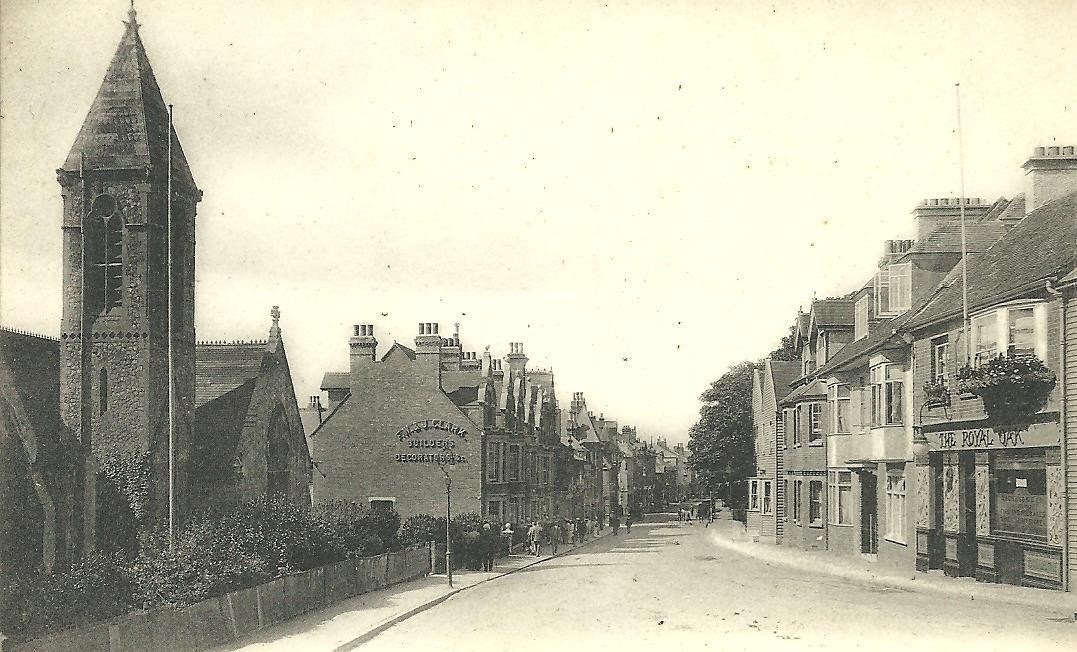
Seymour Villas complete with Clarks signage from Sandgate Hill 1905
Frederick and Joseph’s business continued to flourish, building houses in St Winifred Road, Quested Road and Broomfield Road, Cheriton along with houses in Chichester Road, Sandgate and 50 houses in Seabrook Road, Hythe up until the outbreak of War in 1914.
During the war like many Sandgate men Joseph joined up to serve his country whilst William Clark continued on his own with his business based at 88 Radnor Park Road.
After the war Joseph returned to the building business on his own, trading as J S Clark. One of the first projects he completed was a pair of villas in Granville Parade followed by a house in The Crescent and more houses in Seabrook Road. In 1929 he moved his expanding family from 1 Seymour Villas to a large property that he had built for them on the corner of Military Road and Enbrook Road. It was given the name Warley after a village in Essex, (now a suburb of Brentwood) where his wife Mary Ann Clark was born.
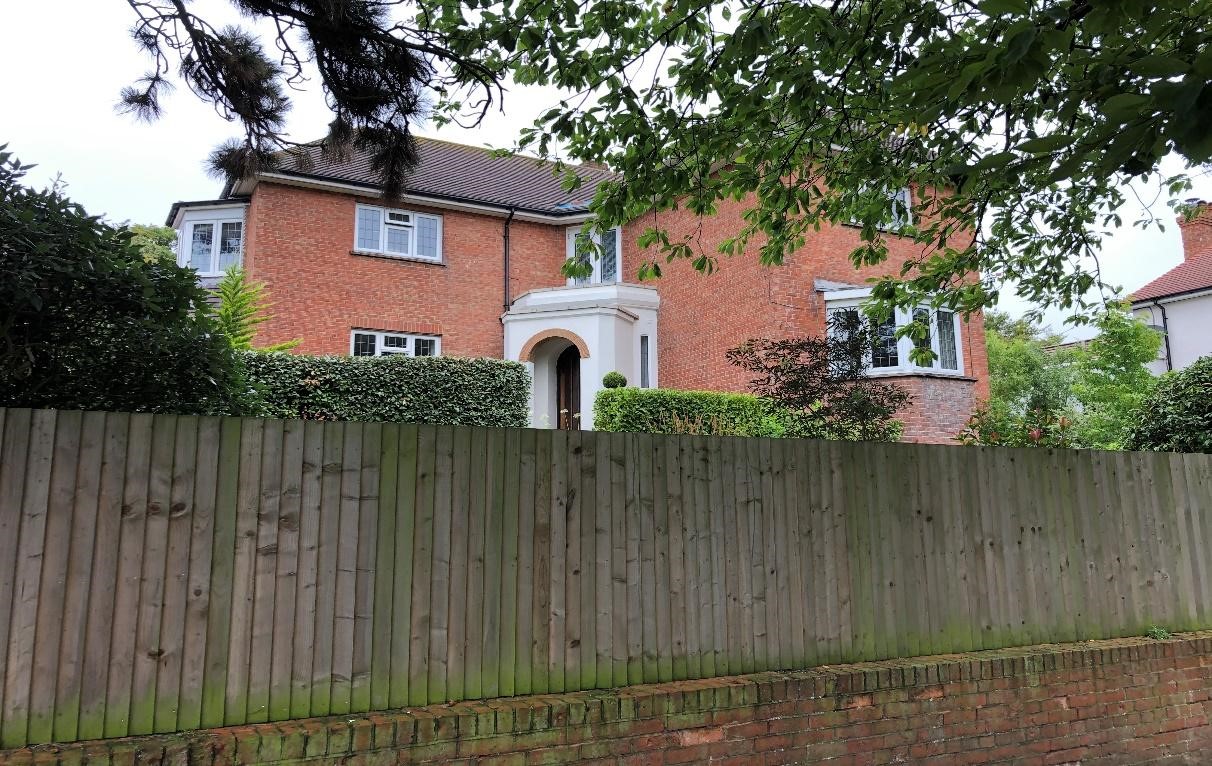
Present day photo of Warley, the Clark’s family home.
Joseph continued to trade from 1 Seymour Villas with his nephew Horace Baker living in the house until the business closed in 1939 possibly due to the outbreak of war and Joseph Clark retired.
His Life
Joseph Seymour Clark was born in Dover on 17th December 1871 to Margaret Ann (nee Whiting) and William Whitaker Clark, a blacksmith. Joseph was part of a large family with 7 brothers and sisters, Frederick William, Emily, Lavinia, James Henry Whitaker, Eliza, Margaret A, and Clara Clark. The family moved from Dover to 6 Fenchurch Street, Folkestone in about 1877.
After moving to Folkestone Joseph attended St Mary’s School and when he had finished his education he was apprenticed to a local firm of building contractors. The family was dealt a double blow with Joseph’s mother dying in 1883 and his father dying two years later on 9th February 1885 aged 50. Joseph went to live with his sister, Emily, her husband and two sons at Grace Hill Cottages, Folkestone.
At the age of twenty-one on 4th February 1896 Joseph married Mary Ann Bacon at St John’s Baptist Church, Folkestone setting up home at 20 Shorncliffe Terrace, Cheriton Road, and went on to have three daughters, Lily Kate, Mabel and Gwendoline Lucy Clark.
On the outbreak of War Joseph Clark, previously a territorial in the Kent Cyclist Battalion, joined the Royal Engineers as well as serving as a Special Constable for the police in Sandgate during the war and was awarded a medal and commended as Head of the Specials at a ceremony in 1922.
Joseph played an active part in Sandgate civic life. He was a Freemason being initiated into the Castle Lodge on 8th June 1906, as well as being Captain of the Sandgate Fire Brigade serving in the Brigade twenty years from 1907 to 1927. He was a Justice of the Peace at Seabrook Magistrates Court for a number of years and was elected onto Sandgate Urban District Council for over twenty years, being Chairman on eight different occasions.
In 1934 Sandgate Urban District Council was dissolved when Folkestone’s boundaries extended to Sandgate and Joseph became an Alderman on Folkestone Council and for two years he was deputy Mayor. On the death of the Mayor of Folkestone, Alderman George Gurr in an air raid in June 1941 Joseph took his place and finished the term in November 1941. Gwendoline his daughter taking on the duties of Mayoress.
Joseph died suddenly and unexpectedly on Monday 19th January 1942, having just returned from a meeting of the Folkestone Town Council Watch Committee, he sat down for tea, collapsed and died. He was buried in St Martin’s Churchyard where his wife had already been laid to rest 27th March 1941.
Notes – Unfortunately I cannot find either a good photo of Joseph or find a headstone for him in St Martin’s Churchyard. I am still looking for both.
Annie Bamford 2021