The Shorncliffe Trust have produced a video “Meeting Stanley about Stanley Robinson – Son, Father, Grandfather and WW2 veteran from Folkestone, but born and brought up in Sandgate.
Stanley is an quiet, humble man, who thinks he is an unremarkable man – but he is definitely not. He is a Poet and an inspiration to us all at the age of 98.
To Stanley and the surviving veterans of WW2 – thank you for your service.
The first 10 minutes of Remembering Stanley centers on his early life in Sandgate, through to his time in the Home Guard as a teenager, keeping guard on Sandgate Castle.
As I approach down Sandgate Hill The village comes in view below me Resting quietly by the sea, So familiar yet still it draws me On past the old school and St Paul’s And buildings, some still as I remember When as a child I wandered freely Between fields and seashore, the village’s splendour At the memorial, a seat to sit and dream The house where i grew up, and in its place A new sign now proclaims ‘the village green’ I think of days spent swimming, When summer seemed to last forever Unseen through my child’s eyes, that with time All things change, not least the weather However, our memories don’t fade, they stay Locked in our minds, that special place, And for me it is and always will Be the little village at the bottom of Sandgate Hill.
If you have the time to spare, I have memories to share Of bygone days and those I used to know Lasting images of some who went before Emerging from the shadows to command the stage once more In summertime we played upon the sand On Sundays we would go for walks then listen to the band I remember “primrose cottage” and “honeysuckle farm” The village church will never lose its charm The clocktower bell will mark the hour of day In the fields the men would gather hay Beside our house a winding path leads down towards the sea There were swings and slides and donkey rides I still recall the way life used to be From his brightly painted barrow Mr Ross sold ice cream Were they really one a penny? Or was this all a dream? Darting seagulls claim the sky throughout the day Fishermen ran pleasure trips around the bay We would make our way down to the beach Casting pebbles from the waters edge to see how far they reach Then walk along the shore to see what we may find Floating treasure that the tide may leave behind The book of life will turn a page and little has remained The distant past like youth itself is not to be regained Every season has to end, winter storms bring rolling waves To break upon the shore, the carefree ways of childhood days Will stay forever more…
I was born at 18 Sandgate High Street on 2nd December 1945 the eldest child of my parents Jeanette (Doris) and Tom Champion, next in line came my brother Allan, then my sister Jeanette (Jenny). My parents had met and married whilst both were serving in the army during the last war and I made my appearance after the war was over.
Number 18 Sandgate High Street no longer exists, the land where it used to be is now known as the Village Green, but when I lived there we lived in the end house of a row of four, two three storey houses and two with two storeys; its hard to believe now that there were four houses on that green butting up to what is now Gate 28.
I will start off by telling you some of my family history, my great grandparents came to Sandgate around 1875, they had previously lived in Cheriton and moved into firstly a house in Wilberforce Road and then into a coastguard cottage as Great Grandfather James Jago was a retired coastguard, who was at that time a lifeboatman. Its hard to believe that he and my Great Grandmother Elizabeth lived in one of those tiny cottages with their eleven children (which included one set of twins), one of whom was my Grandma Jeanetta. Elizabeth Salter as she was came from Cork in Ireland and had met James who came from Cornwall when he had been posted to Cork with his work. Apparently James was one of twins and his brother eventually married Elizabeth’s sister but we know little of those two.
James was one of the lifeboat men who was on the lifeboat that went to the rescue of the Benvenue, a large ship that was ran aground just off Sandgate in 1891, and he was subsequently awarded the Benvenue medal by Queen Victoria. Several of my great uncles served in the Royal Navy and two went on to loose their lives in the first world war, and are mentioned each year at the Remembrance Service on the roll of honour at St Paul’s Church. There are also two bronze plates one in each of their names which were presented by our family to the Sandgate Society and are at present on show in the Sandgate Library. Apparently a plaque was given during the first world war to the families of all service personnel who were lost in the conflict. After James died and many of the children had grown up and left home my great grandmother moved into 18 Sandgate High Street along with my grandma Jeanetta (Nettie). I have since learnt that one of their near neighbours were the Moore family and Fred Moore was delivered into the world by Elizabeth my great grandmother! Now anyone who lives or has lived in Sandgate over the last 60 plus years knows of Fred Moore, who has contributed so much to the Village firstly as being our shoe mender and secondly of course for his long and very rewarding association with the Scout troupe in Sandgate.
When I was growing up in Sandgate the Village was quite different from what it is now, both in terms of the buildings there were and many of the ones we have now, and the fact that we were quite independent from nearby Folkestone and Hythe with regards to shopping and the services we required. We had three churches, St Pauls that is the only remaining one today, then there was the Methodist Church in Gough Road, which was pulled down many years ago, and flats were built on the site; and then further down the High street was the Congregational Church, known up until recently as The Little Theatre and occupied for many years by FHODS. This has recently been sold and is being turned into residential properties although thankfully still retaining some of its former glory on the outside.
There were nine pubs that I can remember although of course as a child growing up in Sandgate they held little interest for me, however I remember those that we used to have as The Oak, just past St Pauls on Sandgate Hill. The Fleur de Lis and The Military Tavern (known locally as ‘The hole in the Wall’ both up near the Memorial. The Kent Tavern in the High Street burnt down as I believe and long gone and The Rose opposite the Coastguard Cottages, all the buildings still there but now put to other use.
I should like to take you for a walk around Sandgate as it was when I was a child, in the High Street starting just past our four houses( The Village Green) we had a builders shop D.I.Y. you would call it now, then Sillibourne’s that was a ladies drapery shop run by would you believe a lovely and very smart lady called Millie Sillibourne! I was always sent along there to buy Mum’s ‘nylons’ and was filled with amazement at the elegant lady behind the counter with her immaculate nails and hair dressed in the height of fashion and in Sandgate High Street! On past there we arrive at Mr Bleach the butcher’s then the Co-op next door, several strides down the road a Radio shop where I can remember taking the acid battery back to exchange for a new one for our wireless. There was a smart ladies hairdressers where the garage now stands and then the Chichester Hall. We had some lovely times there, I can remember being on the stage when I was quite small and singing ‘any umbrellas’ whilst twirling a big black one above my head!, then there were the jumble sales which Mum nearly always helped with and I went along to as well. Across from North Lane was and still is Fred Moore’s shoe shop and next to that Showlers Fruit and Veg. Then we had the post office, the bank and then N.O.Bakers the builders known to all and sundry as Nobby Bakers!
The next shop was the bike shop and then the big International Stores, we had a dairy on that row another fruit shop and also the ‘bottom paper shop’ (the ‘top one’ being opposite the memorial) both owned by the Burden family, and a wet fish shop, that takes us to the Congregational Church. A long way past there opposite the coastguard cottages was another shoe menders where now we have a grassed area and that was called Cramps, and just up on the corner of Wilberforce Road was a Dairy, which alter became Googe’s Taxis and of course the Sandgate Laundry in Wilberforce Road.
As we cross over the road and start back down the High Street we had a little café and sweet shop called Friths now residential, and further up the Bevan Convalescent home stood Georgiou’s a wonderful delicatessen shop and also in that row were a tearooms and a chemist. The Kent Hotel or Kent Tap as it was known was along there and as I remember an off licence. Across the little road has always been the Ship Inn, where as an adult my husband and I often took my Uncle Bill for a pint with the hopes that he would tell us some tales of his life in the Royal Flying Corp! There was a bookshop and Greenwall’s antiques and then a radio repair shop followed by the wet fish shop owned by Mr Phillips. The Sandgate Library was next where I spent a great deal of my time as a child deciding which book to borrow next being even then an avid reader, and of course the old Fire Station. Next door to the Providence Inn and on the corner was the Seabreeze Café run by Mrs Stone, this was long ago closed and incorporated into the Providence. Nordens Antique Shop was the only and original shop of its kind in Sandgate for many years and is still owned by Elizabeth the daughter of the owners who had it when I was a child. Right next door was a small butchers I forget the name of it as we used the other one! And then Chaplains the Chemist with the men’s barbers next to that.
Across Granville Road we had a greengrocers on the corner and next to that the dry cleaners; and then we came to the Bakers – Ludlows, how we loved the smell of fresh bread and cakes when sent shopping and the lovely lady who served us who was called Valerie, and nothing was too much trouble for her. Next door where the little clock shop now stands was our ‘little sweet shop’ almost exactly opposite my house, and being a bit of a chocoholic even in those far off days was temptation incarnate when given any pocket money! Then we had the Fleur de Lis pub and opposite the ‘big sweet shop’ with even more variety of temptations but not quite so handy, run at that time by Mr Pope.
Now we’re up to the ‘top paper shop’ where when I was old enough I did a paper round for Mr Burden for several years before leaving school. Miss Browns toy shop was next and what an exciting place that was it was stuffed to the rafters with every toy imaginable, I remember going in there and longing to be able to buy something but would never have been able to decide just what. She also stocked wool and craft items and when older I used to often have wool put by whilst I plodded on with a jumper or cardi hoping to get it finished before my layby time ran out! Then we had the ‘Swiss Miss’ a coffee bar come café where people used to meet run by Mr and Mrs Sammie I couldn’t wait until I was old enough to sit on one of the stools at the counter and have a coffee in there. As I remember next door was a grocery shop but I’m unsure of its name; so you see Sandgate when I was a child had everything you could wish for we really didn’t need to go elsewhere except for a treat.
It was a wonderful place for a child to grow up in we were never short of things to do and places to play; of course there was the beach and at that time there were still large chunks of the Castle wall laying on the beach directly in front of the castle. These made wonderful ‘ships’ to play on, we all bagged one each and would each be in charge of our ship until the tide came in to claim it back. We would go rocking at low tides, usually to the rocks down and Rex Cinema all long gone and now blocks of flats. At the corner of Devonshire Terrace in front of the esplanade and spend hours looking for crabs and different sea weeds. My cousin and I also used to collect shells which we stored in massive empty soap powder boxes that we had begged from one of the shops and which we filled with so many shells that we couldn’t lift them up to go through our ‘treasures’. We would often climb the wall into the castle which was not occupied in those days and wander down the underground passages, I remember once my brother and I came across a very old huge bible in there and I often wonder what became of that.
Up the back of the village was the Undercliff where most children had a ‘camp’ my brother and his friends certainly did and another place for good fun was in the hay fields when they had all the hay made into large square bricks, which we would stack up to make a den. Where the Golden Valley now is was a huge area know as the Cow Fields which was wonderful in the winter when we had had heavy snowfalls, we would all go up there with tin trays or the luckier ones with their sleighs and zoom down from top to bottom not caring about how cold or wet we got, and once at the bottom couldn’t wait to get up to the top again! Of course I must mention the ‘Rec’ as it was affectingly known as locally with swings and slides and lovely grassy hills to role down, where as we got older some of us would use the tennis courts of watch the grown ups on the bowling green, such lovely days.
Thankfully Sandgate primary school still stands a lovely old building, although sadly no longer used as a school, I did not go to that school as when I was about four and a half my mother decided that I needed to go to school and the local school was at that time full up so I ended up going to St John Moore School at Shorncliffe. I loved it there and got a very good start in education however it did rather distance me from the children of my age in the village, my friends at that time came mostly from army families or from Cheriton. I did make one really good friend Angela whom I am still in contact with today 57 years down the line! We had many activities going on in the Village, cubs, scouts and sea cadets for the boys and brownies, guides and girls life brigade for the girls. Various dancing and music lessons were available to which my Mother managed to send me to which I am always so grateful that she did, as money was not very plentiful in the years following the war.
In concluding my memories of a childhood in Sandgate I should like to say that when I got married and moved away to live for many years in London, Essex and Lincolnshire my heart was always in Sandgate. We have visited many times every year as my Mother, sister and brother and the rest of my family were all still here, my husband made me a promise that when we retired we would return, which happily we did just over five years ago. I have even got back in touch with many childhood friends including my dear friend Pam Sheppard (Hodgeson that was) Although we don’t live in Sandgate we are not far away and I have the privilege of being a member of the Committee of the Sandgate Society, and feel that I have gone full circle and returned home!
Jill Partridge was born to Jeannette and Tom Champion at 18 Sandgate High Street (The Village green is now to be found in its place) on 2nd December 1945. Her parents met whilst serving in the army in the last war. Her Great Grandparents in 1875 lived in one of the Coastguard cottages with their 11 children! Her Great Grandfather James was a retired coastguard and a lifeboat man.
Jill remembers her childhood well and some of the familiar shops which were in Sandgate when she was a child – she can clearly picture Sillibourne’s a ladies Drapery Shop where she was sent to buy her mums nylons – the lady who served her was dressed in the height of fashion, Jill was amazed by this and her manicured nails and hairstyle.
N.O. Bakers the Builders was known to all as Nobby Baker’s and the Chichester Hall was where she sang “Any Umbrellas” up on the stage whilst twirling a black one above her. Jill also enjoyed the local jumble sales where her mum would often help out.
Then there was the Bakers – Ludlow’s where you could smell fresh bread and cakes and a lady called Valerie served her, Jill recalls that “nothing was too much trouble”. As a child Jill spent a lot of time in the library, even then she was an enthusiastic reader. She enjoyed visiting Miss Browns Toy Shop which was stuffed to the rafters with every toy imaginable!
Jill says that there was always something to do in Sandgate and going to the beach was one of her favourite activities, she would spend hours with her friends playing ships on pieces of castle wall which were laying on the beach. Rock pooling was also a much-loved activity and she would “go rocking at low tides, usually to the rocks down in front of the Esplanade and spend hours looking for crabs and different sea-weeds”. Whilst she was still at school, Jill did a paper round for Mr Burden at the Top Paper Shop. However, Jill has not spent all her life in Sandgate. She married and moved away to live in London, Essex and Lincolnshire but her “heart was always in Sandgate”. When they moved away, her husband made her a promise that upon retirement they would relocate to Sandgate area. Jill feels very privileged to be a member of the Sandgate Society Committee and comments she has finally returned “home”.
JUNE 2027 across Hythe, Saltwood, Seabrook & Sandgate
Do you live in Saltwood, Hythe, Seabrook or Sandgate? Would you like to be involved in this new community project?
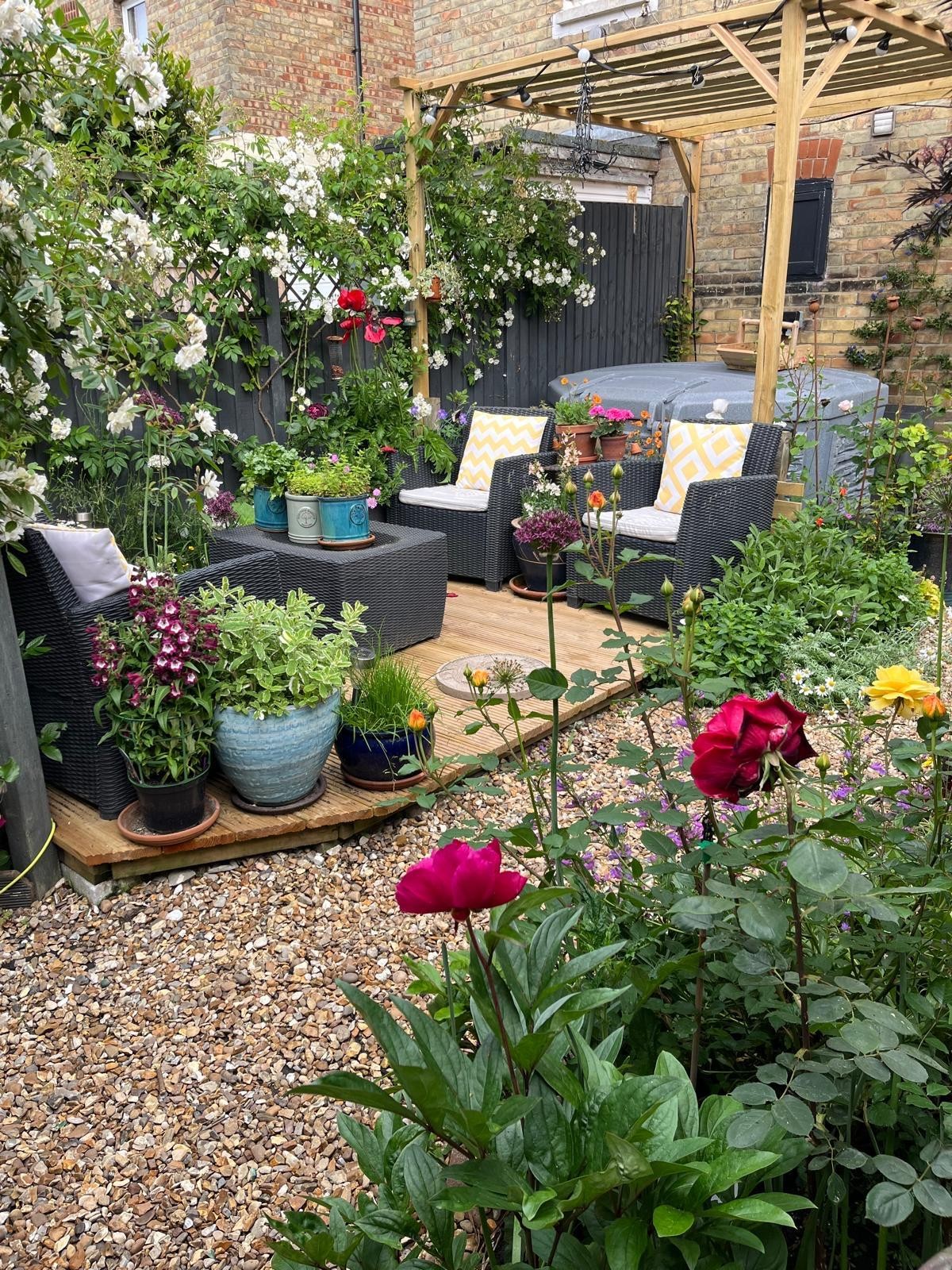
We are looking for gardens / allotments / community spaces etc to open to the public in June 2027. Whether your space is large or small, a weedy wildlife haven, a family friendly veg patch or a secluded courtyard full of pots, we want to show off the diversity of plants and planting schemes in our neighbourhood.
It doesn’t matter if you are new to gardening or have a wealth of horticultural knowledge, everyone is welcome. All proceeds from this event will go to local charities.
HOW TO GET INVOLVED
If you are interested in opening your garden / gardening space, interested in volunteering or would like to know more, Heidi will have a stall at the Big Green Fair so please come along and find her or email Heidi at h2sopengardens@gmail.com
Lilla, baptised Elizabeth Mary Bligh, was born in Stockholm, Sweden on 22nd March 1837. She died aged 47 on 7th December 1911 at Enbrook. Elizabeth was the daughter of Sir John Duncan Bligh and his first wife Elizabeth Mary Gisborne.
Sadly, Lilla’s mother died on 22nd July 1837 aged 22 just four months after giving birth whilst living in Stockholm. Lilla’s father Sir John Duncan Bligh then tendered his resignation from his post at the Embassy to the Court of Stockholm.
On the 18th June 1861, aged 24, Lilla married Walter John Pelham (Lord Pelham and 4th Earl of Chichester) at St George’s Church, Hanover Square in London.
Lord Pelham held the office of Deputy Lieutenant of Sussex and in 1865 was elected to the House of Commons for Lewes as a Liberal MP. Source: The Peerage
Their home in Sandgate was at Enbrook built on land owned by John Bligh, 4th Earl of Darnley, Lilla’s grandfather. His son, Sir John Duncan Bligh, inherited the house and land. He rebuilt the house in the 1850s and after his death in 1872 the property passed to Lilla, Countess of Chichester.
Source: Swale & Thomas Survey Co. Undated.
1861 Census shows Lilla living at Enbrook with her father just before her marriage. This census lists five relatives staying at Enbrook and also eleven members of staff ie house-keeper, ladies maid x 2, upper housemaid, kitchen maid, dairy maid, housemaid, butler x 2, coachman and footman.
Information about the Countess of Chichester has been researched through several newspaper articles from which we can discover something of her kind character and good deeds which led ultimately to the Chichester Hall being built in her memory.
The following is from the The Dover Express and East Kent News, Friday 15th December 1911. The obituary article in this newspaper reports on the death of the Countess of Chichester and tells us a little more about Lilla. She was often in Dover in connection with religious work and how she was held in great esteem in Sandgate with the poor having lost a true friend. Lilla also had no family.
“The death occurred early on Friday morning last of Elizabeth Mary, Countess of Chichester, at her residence, Enbrook, Sandgate, Kent. The late Countess, who was often at Dover in connection with religious work was the widow of the fourth Earl of Chichester who died in 1902. Before her marriage, in 1861, she was Elizabeth Mary Bligh, only daughter of the late Hon. Sir John D Bligh, K.C.B., son of the fourth Earl of Darnley. Lady Chichester had no family, and on the death of her husband, his brother, the late Earl succeeded, He died in 1905, and was succeeded by Jocelyn Brudenell Pelham, the present peer. The Countess was greatly esteemed in the Sandgate district, and in her the poor have lost a true friend. A memorial service was held at Sandgate on Monday and the funeral took place at Stanmer on Tuesday.”
The Folkestone Express, Sandgate, Shorncliffe & Hythe Advertiser dated 16th December 1911 gives us more information about Lilla.
The paper reports that “the death of Elizabeth Mary (known as Lilla) Countess of Chichester will be the cause of deep sorrow among a large section of the community in Folkestone and Sandgate, where she had, during her long widowhood’ taken a deep interest in what may be termed the higher life of the people. The various societies which have as their main objective the improvement of the lot of young women have lost by the death of the Countess one who was a tower of strength to them, not only by her sympathy but by her sound practical assistance. At the time when she was ill (only a few days ago) she was announced to take part in various functions having for their object the assistance of those who needed aid. Her last appearance in public was, we believe, on November 18th, when she distributed prizes to the pupils in the Girls’ County School, and gave a most encouraging address to the girls.
The memorial service was held at St Paul’s Church, Sandgate. The coffin, on which rested a number of beautiful wreaths, was taken from Enbrook to St Paul’s by members of the Sandgate Fire Brigade by the private entrance. The firemen, who were commanded by the Capt W H Jacob and Lieut J S Clark, wore their uniforms and helmets. Drawn up outside the church was the Sandgate detachment of the Red Cross Society and also the members of the St John Ambulance Brigade, both contingents being in uniform. The service was attended by a large and representative congregation. One floral wreath from members of the household ‘desired that this floral harp may express their deep attachment and respect for their beloved lady’. The coffin, after being removed from the church, was placed on the funeral car and taken to Shorncliffe Station, to be conveyed to Lewes by train, and thence to Stanmer, where the family mausoleum is situated.”
The Whitstable Times & Herne Bay Herald, dated 16th December 1911 informs us that the memorial service was held in Sandgate Church. On 2nd March 1912 the same newspaper tells us about the estate left by Lilla.
“The estate left by the late Right Hon, Elizabeth Mary Countess of Chichester of Enbrook, Sandgate, widow of the fourth Earl of Chichester, has been sworn at £31,613 gross. Testator left the residue of her estate to the Central Branch of the Y.W.C.A. Brighton, the Police Convalescent Home at Hove, the Girls’ Shelter,
Buckingham Road Brighton, the Connaught Institute, Lewes Road, Brighton, and the C.M.S.”
Y.W.C.A. is the Young Women’s Christian Association C.M.S. is the Church Missionary Society
The Folkestone Express, Sandgate, Shorncliffe & Hythe Advertiser dated 28th February tells us a little more details of Lady Chichester’s Will.
Lilla bequeathed many personal items and monetary gifts to a long list of recipients. Some examples of bequeathed items are listed herewith: to Lady Dorothy Bligh, an opal and ruby pendant and twelve books: to Lady Kathleen Brownlow, a band bracelet with diamond buckle and sapphire and diamond ring: to Lady Alice Bligh, a pearl ring: to Lady Ruth Pelham, a group of Chelsea china: £6,000 to the Earl of Chichester: £10,000 to Miss Mary Louisa Pelham: £1,000 to her god daughter, Lilla Morris and so on. The residue of the estate divided between charitable institutions.
The Chichester Memorial Hall
The Chichester Hall was built as a lasting memorial to Lilla (Elizabeth) with funds raised through public subscriptions by residents who wished her to be remembered for all the support she had given to Sandgate over the years.
The Folkestone Express, Sandgate, Shorncliffe & Hythe Advertiser dated 20th December 1913 reports on the stone laying ceremony for the Chichester Hall.
“There was a large attendance, on Monday, at the memorial stone-laying of the working men’s club, which is being erected in the High Street, Sandgate, in memory of the late Lilla Countess of Chichester, whose interest in Sandgate and its residents will not be forgotten for many, many years. Mr C H Master, Chairman of the Chichester Memorial Committee, presided over the proceedings and the ceremony was performed by Sir Squire Bancroft.”
Mr Master went on to say that “the Gough Home was first of all suggested, and it was almost purchased. They were just about to settle the purchase, when it was sold over their heads. He, however, did not regret that fact now. He thought the Gough Home would not have suited their purpose in every way, and it would not have been sufficiently good enough or capable of being used for the purpose. They then tackled the question of buying the site, and the imposing old ruins which stood there were bought for £400. The contract for the building was £1,200, and there would be some odds and ends which would cost about £200.
Towards the total they had got £800, and the consequence was that they wanted £600 more, and he appealed to everyone who had the interest of Sandgate at heart help that matter on, so that they could get the debt paid off………. they wanted a big room, a place where they could have evening entertainments, and which could be used for a hundred other things……Mr Conquest, the architect , then stepped forward and presented to Sir Squire Bancroft a handsome silver trowel with ivory handle, as a memento of the occasion.
The trowel bore the following inscription ‘Presented to Sir Squire Bancroft on the occasion of his laying the foundation stone of the Chichester Memorial Hall, Sandgate, December 15th, 1913.’ In Sir Squire Bancroft’s speech he “yielded to none in his sincere regard for all the acts of kindness shown to Sandgate by the late Lady of Enbrook. His wife and he enjoyed the privilege of Lady Chichester’s acquaintance and shared the true regret in her loss which they all felt. The Contractor was Otto Marx and the Architect C J Conquest. Copies of local papers will be placed in the cavity at the back of the memorial stone which was inscribed Chichester Memorial Hall. This stone was laid by Sir Squire Bancroft, 15th December, 1913.’”
NB The silver engraved trowel was the work of Messrs Oclee & Sons of Folkestone.
Mr Arnold H Ullyett (Hon. Sec. & Treasurer) advised in a letter dated 22nd January 1914 that the committee received a generous offer from Mr Master and Mr Burke who promised to give jointly a cheque for £250, provided a similar sum of £250 is subscribed within 6 months.
The clock was relocated to the Chichester Memorial Hall but was originally installed on the J B Gough Soldiers Home at 56 – 60 Sandgate High Street. It was renovated in 1981 again in 2009.
The Dowager Countess of Guildford unlocked the entrance door to the Chichester Memorial Hall and declared the building officially open on 10 June 1914.
The Chichester Hall has been at the centre of village life and events for over 100 years and the main hall is hired and used regularly by clubs, groups, meetings, music events and organisations on a regular basis including a Farmers’ Market.
It has been interesting to try and discover more about Lilla Countess of Chichester, however, if you have any documents or photographs that we can copy/add to the records in our archives please do contact us.
The Railway Mania in the mid 1800s was a classic bubble. Middle class money was thrilled to be part of this huge social enterprise. From 1843 to 1846 hundreds of companies were formed with shares duly issued in anticipation of the required Act of Parliament to commence the purchase of land. Sadly in 1845 Bank interest rates rose providing a less risky home for savings. Overnight share prices collapsed and the nascent railway boom hit the buffers. Large landowners, though, had the capital to acquire bankrupt companies and proceeded with plans to open up their estates to commercial exploitation.
The Duke of Devonshire saw a line to Eastbourne open in 1849, while three years earlier Sir Richard Hotham’s Bognor was rail linked to London. On the east coast the Earl of Scarborough’s landholding in the wilds of Lincolnshire was developed into the happy holiday resort of Skegness, offering relaxation and frivolity for the tobacco workers of Nottingham and industrial powerhouse of Derby. Once a railway was planned, entrepreneurs soon grasped the opportunities for housing development.
Into these fevered times stepped Sir Edward Watkin, Manchester born, he was a visionary a century before his time. He was Chairman of London’s first underground system, the Metropolitan Railway. He planned a tunnel between Scotland and Ireland – and in 1880 dug two miles under the sea at Dover to develop a Channel Tunnel. In the north he created the port of Grimsby and its neighbouring resort Cleethorpes, while in 1899 his Grand Central Railway opened from Manchester to London’s Marylebone. He also campaigned in Parliament in 1867 to give women the vote. Abroad he rescued the bankrupt line across Canada to form the Canadian Pacific Railway. So why would he trouble himself with a three miles branch line from Westenhanger to the village of Sandgate? His vision was to create an alternative route for cross-channel freight and leisure.
The line from London to Folkestone Junction opened in December 1843, reaching Dover the following year. Folkestone West (named Shorncliffe Camp until 1962) opened almost twenty years later. The South Eastern Railway also built a new more accessible station in 1884, Cheriton Arch – renamed Radnor Park in 1886 and Folkestone Central by 1895.
A rival service to the continent was also built by the London, Chatham and Dover Railway – reaching Dover by 1861. Two rail lines now converged on Dover, but the SE Railway had developed Folkestone Harbour from 1844 and was determined to fight back. Sir Edward Watkin had a vision of a spur leaving the main London line at Westenhanger and being routed along the coast to Folkestone via Hythe and Sandgate. The final link would have involved a line passing close to Sandgate Castle and thus onwards along the cliff to Folkestone Harbour. Sadly, Watkin hadn’t reckoned with the wiles of the Radnor Estate, leading to a thirty year battle, ending in stalemate.
The first sod of the new Hythe and Sandgate Railway was dug by Prince Arthur of Connaught, grandson of Queen Victoria, on Thursday 11th April 1872 at Cannon Gate, Hythe, sadly the spade snapped in two but the Prince gallantly used the lower portion to transfer the turf to the barrow.
Work on the line continued at pace and the first London train streaked into Hythe Station on Friday 9th October 1874 at 11.40am. Prince Arthur was unable to officiate but taking his place was Prince Francis, Duke of Teck, whose daughter, the eventual Queen Mary, had been born seven years earlier. His later life was rather colourful – gambling and womanising being his favourite hobbies. In his will he left the family jewels to a mistress and also created the concept of secrecy by ‘sealing the Royal will’ – a practice that continues to this day. The actress Sarah Miles claims to be the great- granddaughter of Prince Teck from his liaison with a seamstress – further details in her memoirs, A Right Royal Bastard.
Back at Hythe Station in 1874 the whistle blew for the short journey to Sandgate, where Prince Teck was shown the waiting room and the booking office. Back in Hythe the party was met by local dignitaries, school children and a Military Band. The 300 guests were then taken down to Rampart Road where a huge marquee had been erected for a sumptuous celebratory meal. From the following day a regular seven day service ran, the first train departing Sandgate at 6.15am and the final service arriving back into the station at 9.10pm. A Goods Traffic service later commenced on Friday 1st January 1875. Five years after the Sandgate branch opened, a new station was built at Westenhanger, and the original branch station was renamed Sandling Junction.
During its heyday the line was advertised across London stations by Thos. Cook offering a Rail & Tea Excursion for 3/9d. Breakfast, Lunch and Teas were served at the Grosvenor Hotel, Sandgate. ‘The village is an ideal spot for a Day’s Outing, there being excellent facilities for Boating, Bathing and driving.’
Sadly, the line was never extended into Folkestone – Sir Edward Watkin had fought for nearly three decades but vested interests forestalled his dream of a rival route to the continent. The Railway King died in 1901 and there was no enthusiasm within the company for more investment. The final train ran into Sandgate on Tuesday 31st March 1931 saving annual wages of £679. Hythe survived for a further twenty years with its final closure on Saturday 1st December 1951.
The people of Hythe were enthusiastic when their station opened, and on its final day 77 years later, railway fans were back on the platform for an hour to say farewell to a treasured friend. A special wreath was made, of various vegetables and was placed on the engine front. At 4.20pm the whistle sounded and the packed train ran over two detonators creating loud explosions as its final parting shots.
This was all in contrast to the reaction in Sandgate. On the very first public train out only two passengers alighted – while on the final journey in 1931 again only two travellers left the train. Sandgate held no opening celebrations nor final farewells. The East Kent Bus Service soon bought up to the site and from 2005 the Corniche housing estate was built on eastern part of the station platform.
Walking access is restricted now but views of the old line can easily be seen between Seabrook and Saltwood. The Hayne tunnel remains intact although impassable due to flooding.
For a very thorough history of the branch line, Brian Hart’s exhaustive “The Hythe & Sandgate Railway” book is highly recommended.
The Hayne Tunnel is easily accessible from the car park at Sandling Station, but impossible to walk through. Here we see a film crew using the historical atmosphere to create memories of the rather underused Hythe & Sandgate rail line.
There have been over the years many pubs, clubs and hotels in Sandgate in fact at one time it was reported there were over thirty pubs alone in Sandgate, also several breweries. I thought this tale might be of interest to the reader so we need to start way back in the late 1700s!
Although we know that the Castle in Sandgate was built in 1538 by order of Henry VIII, and the first houses recorded in the Village were the shipbuilder’s cottage in the late 1700s, the first pub that we have found mentions of was the Rose Tavern in Prospect Road which was there in the 18th century. Sadly we have not got a definite date for it, the premises had formerly been called Lawn Cottage, but no record of how long it was in business!
1717 – Sandgate House whose location is unknown however was on a list of Folkestone Beer houses but was most likely in Sandgate although the boundary between Folkestone and Sandgate, at that time ran from the foot of Sandgate Hill by the Fleur de Lis.
1725 – Fleur de Lis at 23 Sandgate High St. was in business from the 1700s to 1974. At one time there were only 3 houses in Sandgate one being the Fleur. It was said to have been a meeting place for smugglers, also a haven for shipwrecked sailors in times past. In 1888 it was almost completely rebuilt and extended. Apparently, it was in the Flisher family who held the licence for 175 years from the 1740s
1765 – Sandgate Fort was in business until 1772, location unknown however it is thought it possibly became the Castle Tavern in the High Street
1775 – The Royal Kent and Tap, formerly the New Inn, a wonderful old Coaching Inn in the High Street. Very up market with a garden leading down to the sea. Over time had many famous visitors inc. Queen Victoria when she was a Princess along with her mother!
1792 – 1804 The Trotting Horse, which stood on Castle Green
1792 The Good Intent unsure of this exact location but possibly in the vicinity of the Castle, nor how long it was in business
1789c to Present Day Ship Inn documents show when it was built. It is recorded that in 1838 a Mr Hogben was a fishmonger and beer retailer there, from 1890, beer only was served and the fish shop had ceased trading, extensive alterations took place. In 1929 it was granted a full licence to sell beer wines and spirits. There is said to be a ghost on the premises of a fish lady whose appearance is accompanied by a strong smell of fish!
1805 – Present Day Royal Norfolk Hotel, formerly named The Ship, it was first referred to as the Royal Norfolk in 1864 after the Duchess of Norfolk and her children enjoyed a long stay there. In 1901 the old building was demolished and the new building was opened in 1902.
1805 – 1911 Castle Tavern, formerly the Martello Tower 11 High St
1815 – 1911 Duke of York was located a few buildings east of the Royal Norfolk; in WW1 it became the Allies Café and stayed that way for a number of years latterly known as Bougie Bistro, now a house
1825 – 1914 The Alexandra Hotel & Alhambra Theatre, formerly The Bricklayers Arms 103 High Street, finally becoming The Rex Cinema, now an apartment block stands there.
1830 – 1871 Victoria Tavern – located where the Memorial now is
1838 -1864 Good Intent – possibly. in Castle Rd, where York House is
1838 – 1862 The Marine Hotel stood in the High Street, where the Coastguard Cottages are now.
c1843 – Present day TheProvidence Inne 47-49 High St. the exact year of opening is unknown, 1826 Directory lists John Elgar as a Pork Butcher, 1838 now a butcher and beer retailer, 1852 Slaughter house built at the back. In 1854 named the Providence Inne, in 1970s extended into the Seabreeze Café which stood on the corner
1841 – 1869 Duke of Wellington in Chapel Street (Wilberforce Rd)
1843 – 1869 The Sebastopol in the back half of the Ship Inn
1843-1852 Brewery run by Richard Hills at Hillside transferred to Brewers Hill in 1852
1851 A Brewery run by Frederick Sladden in Camp Road, that became Ordnance Rd which by 1896 was known as Brewers Hill
1854 – 1858 Alma exact location not known possibly in Military Rd where Alma Cottage now stands
1855 – 1871 British Flag in High St, poss. loc. next to Sandgate café
1856 – The Union on corner of Military Rd and the High Street possibly became the Military Tavern
1857 – 1869 Duke of Cambridge location unknown poss. in High St.
1858 – 1866 Allied Arms exact loc. unknown poss. close to the British Flag & George Worsalls Butchers shop
1858 – 1869 Prince of Wales formerly Inkerman Arms loc. unknown
1859 – Flower Pot location thought to be in High St. opp. Providence
1859 – 1869 City exact loc. unknown except that it was in High St.
1859 – True Briton formerly the Duke of Cumberland
1859 – Present Day The Clarendon Brewers Hill was damaged in the landslip of 1893 when they were unable to cook for customers! now named The Earl of Clarendon
1861 – 1869 Victoria Beer House in the High St exact loc. unknown
1900? The Riviera Hotel, prev. The Conamur School, now Zarina Court, a row of private houses facing the Esplanade, with sea views.
1863 Plates & Basins site unknown
1864 – 1968 Rose Inn 152 High St. listed 1864 was art gallery now residential
1865 – 1973 Royal Oak on Sandgate Hill last licencee, Ena Pafford a retired music hall and ENSA Artiste under name of Ena Dayne lived in the property until her death in 1977 now a private residence
1868 – 1963 Military Tavern on Military Hill (known locally as The Hole in the Wall) 1st Landlord Henry J. MacLachlan aged 18, then in Mills family for many years & last licensees the Fieldsend family
1993 – Present Day The Sandgate Hotel Wellington Terrace
2015 – Inn Doors new to the High Street in August of that year
2018 – Sandgate Vaults new to the High Street from Spring 2018
Sandgate was never short of places to ‘Quench the Thirst’. Of course in the early days when Shorncliffe was home to thousands of soldiers and personal, the pubs and breweries must have done a roaring trade. Then as the population grew and visitors started holidaying in Sandgate which had become well known now as a popular place to go for one’s health; with the lovely beaches and nice walks this kept many of the watering holes in business.
As you can see over time many of the pubs have changed their names and locations and as we are now in the 21st century with the few that have stood the test of time and thankfully are still there and thriving in the village; they have now been joined by a wide range of restaurants and cafés all adding to the wonderful character of Sandgate with its beautiful beaches, 16th century Castle, wonderful walks, and of course The Old Fire Station, our headquarters of the Sandgate Society.
Jill Partridge, Archivist
Coronation Celebration outside The Ship in High Street 1911
The Royal Norfolk with The Woodford Hotel next to it
The Bricklayers Arms, over time the Alexandra Hotel, Alhambra Theatre and lastly The Rex Cinema, now Residential Apartments
Fleur De Lis original Building c1725 The Royal Oak
The Military Tavern ( Locally known as Hole in the Wall)
The Royal Kent Hotel and Coaching Inn, in the High street
The Riviera Hotel prev. The Conamur School, now Zarina Court
The Beach Marine Hotel now Beach Marine Apartments
New Inn where Royal Kent once was, now Sir John Moore Apts.
The Marine Hotel where the Coastguard Cottages now stand
The Providence Inne in 1900s above – and below c1970s
“What really matters is what you do with what you have”
Herbert George Wells was born on 21 September 1866 in Bromley, Kent. He died in London on 13 August 1946. H G Wells commissioned the building of Spade House, Radnor Cliff Crescent, in Sandgate in 1899.
The architect for Spade House was Charles Francis Annesley Voysey (1857 to 1941).
The Builders of Spade House was a local established Folkestone Building Contractor called William Dunk Ltd.
H G Wells wrote to Mr W Dunk on 19 August 1899, whilst living at Arnold House in Sandgate, advising that he was proposing to have a house built between Folkestone and Sandgate and his budget for this new build was £1,200 to £1,500.
A copy of this letter, along with other documents relating to the build of Spade House, has been kindly donated to the Sandgate Society Archives from local retired builder John Steed. These newly acquired documents were discovered when John Steed’s mother passed away in 2017. John’s late father had worked for William Dunk Building firm and over many decades his family has taken great care of these documents.
In 2019 all of the original documents, including letters, paint chart, architect house plans, purchase orders, invoices etc were donated to the RIBA (Royal Institute of British Architects) at the Victoria & Albert Museum by John Steed. The RIBA will conserve and protect these items for the future and they will, in time, be available for the public to view.
However, some of the less fragile documents have been photocopied by John and kindly donated to the Sandgate Society Archive Team for our exhibition.
We would like to share the letter mentioned above with you in this Tales From the Archives.
H G Wells was living at Arnold House in Sandgate at the time of writing this letter to Mr W Dunk on 19 August 1899. The handwriting is not easy to read so a transcript is provided below.
“Dear Sir
I am proposing to build a house of about the value of £1200-£1500 between Sandgate and Folkestone. If you are in a position to undertake such a contract for this work I shall be glad to hear from you.
Yours truly H G Wells”
Christine Bleach /Archive Team/March 2021
Manage Consent
To provide the best experiences, we use technologies like cookies to store and/or access device information. Consenting to these technologies will allow us to process data such as browsing behavior or unique IDs on this site. Not consenting or withdrawing consent, may adversely affect certain features and functions.
Functional
Always active
The technical storage or access is strictly necessary for the legitimate purpose of enabling the use of a specific service explicitly requested by the subscriber or user, or for the sole purpose of carrying out the transmission of a communication over an electronic communications network.
Preferences
The technical storage or access is necessary for the legitimate purpose of storing preferences that are not requested by the subscriber or user.
Statistics
The technical storage or access that is used exclusively for statistical purposes.The technical storage or access that is used exclusively for anonymous statistical purposes. Without a subpoena, voluntary compliance on the part of your Internet Service Provider, or additional records from a third party, information stored or retrieved for this purpose alone cannot usually be used to identify you.
Marketing
The technical storage or access is required to create user profiles to send advertising, or to track the user on a website or across several websites for similar marketing purposes.